
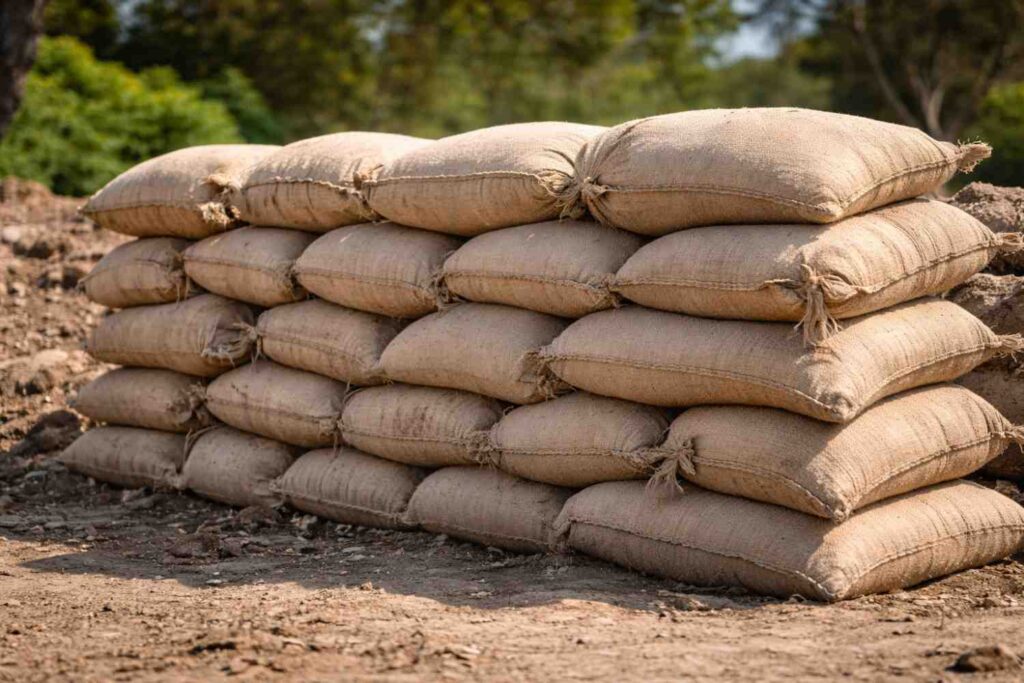
Without fast, reliable sandbag filling, even the most organized flood response can fall apart. When floodwaters rise, every second counts. Emergency crews, municipalities, and homeowners scramble to build barriers, protect infrastructure, and keep water away from lives and property.
At The Bag Lady, Inc., we’ve spent over three decades helping communities across the Northwest prepare for and respond to floods. We’ve seen firsthand what happens when the sandbag filling process breaks down, and what happens when it works the way it should. This post breaks down exactly why filling speed and efficiency are the linchpin of effective flood response, and what teams can do to ensure they’re never caught short.
What Happens When Sandbag Filling Can’t Keep Up With Rising Water
When a flood warning hits, the demand for filled sandbags can spike into the tens of thousands almost immediately. A standard wall just four feet high and ten feet wide requires roughly 78 sandbags per foot of length. For a city block, that’s thousands of bags, all of which need to be filled, transported, and stacked before water arrives.
Manual filling with shovels and two-person crews is the most common approach, but it’s also the most limiting. When filling can’t keep up, the consequences compound fast:
- Barriers go unbuilt: A trained crew working in shifts can fill a few hundred bags per hour at best, nowhere near the volume needed to protect entire streets or neighborhoods before water levels peak.
- Critical entry points stay exposed: Doorways, utility corridors, and low-lying access roads are among the first places floodwater exploits. Without enough filled bags on hand, these vulnerabilities can’t be addressed in time.
- Infrastructure sustains preventable damage: Every hour of delay in barrier deployment is another hour water has to reach roads, electrical systems, drainage infrastructure, and building foundations.
- Response teams get stretched too thin: When filling is slow, the same workers filling bags are also the ones needed for placement and transport, creating a bottleneck that stalls the entire operation.
- Volunteer fatigue sets in quickly: Manual shoveling is physically grueling. Even motivated crews slow down significantly after the first hour, reducing output precisely when urgency is at its highest.
The problem isn’t a shortage of motivation or manpower. It’s a fundamental gap between what manual filling can produce and what a true emergency demands.
Labor Shortages in Flood Response Failure
One of the most overlooked factors in failed flood responses is the growing labor shortage that affects emergency operations nationwide. Municipalities, contractors, and emergency management teams increasingly struggle to put together large, capable filling crews on short notice, especially when a flood hits at night or outside normal working hours.
Manual sandbagging is physically brutal work. Bending, shoveling, lifting 30- to 40-pound bags repeatedly leads to back strain and fatigue very quickly. When workers tire out mid-emergency, production slows precisely when urgency is at its highest. Volunteers and part-time crews are helpful, but they often lack the stamina and experience to sustain high-volume output under pressure.
Read more on how the right equipment addresses this directly: How Sandbag Filling Machines Solve Labor Shortages During Flood Response
How Improper Filling Compromises the Barrier Itself
Speed isn’t the only thing that suffers without proper filling equipment and technique, barrier quality takes a hit too. Overfilled bags won’t lay flat or stack reliably, creating gaps in the wall. Underfilled bags don’t provide adequate weight resistance and shift under water pressure. Either way, the barrier that took hours to build can fail in minutes.
Properly filled sandbags should be between one-half and two-thirds full. This allows the sand to shift and conform to adjacent bags, creating a tight, interlocking seal. It also keeps the weight manageable at around 30 to 40 pounds, light enough to move quickly, heavy enough to hold position. Achieving that consistency at scale with manual shoveling is difficult. With an automated filling machine, it becomes the standard.
When filling is unreliable, the entire system is unreliable. A technically well-placed wall built from improperly filled bags can buckle just as fast as one that was never built at all.
Why Material Delays Derail Even Well-Planned Flood Operations
Having empty bags and access to sand is not the same as having filled sandbags ready to deploy. The gap between raw materials and ready-to-use barriers is where many flood operations lose critical time. Trucks get stuck in traffic. Staging areas run out of fill material. Volunteers show up faster than bags can be produced.
A bulk bag filling machine eliminates this bottleneck by dramatically increasing the rate at which bags move from empty to filled and deployment-ready. Instead of depending entirely on manual crews, a well-equipped staging area can produce bags continuously and consistently, keeping pace with the placement teams working the front line.
For a deeper look at how material delays affect both emergency and construction operations: How Bulk Bag Filling Machines Prevent Material Delays on Emergency and Construction Sites
Why Manual Filling Will Never Be Enough at Scale
The math is straightforward but sobering. A two-person manual filling crew working efficiently might fill 100 to 200 bags per hour. An automated sandbag filling machine like the Megga Bagger can fill up to 1,000 bags per hour on average, far outpacing even the most experienced manual team.
That gap has real consequences at scale:
- For municipalities protecting a mile of floodplain — the difference between having adequate protection in place before water arrives and building a partial barrier that fails
- For contractors on emergency response contracts — the difference between meeting their obligation and facing consequences for under-delivery
- For volunteer crews working overnight — the difference between a sustainable operation and a team that burns out before the barrier is complete
The Megga Bagger was specifically engineered to solve this problem:
- Fully automated — minimal operator input required once the machine is loaded and running
- Portable — trailer and skid-mounted models can be deployed to any location where filling needs to happen
- High-volume by design — built specifically for the high-pressure, time-critical conditions that flood emergencies create
How Municipalities Can Prevent Breakdown Before the Storm Hits
Reactive flood response is inherently limited. By the time floodwaters are rising, the window for adequate preparation is often already closing. The municipalities and response organizations that perform best are those that invest in the right equipment and processes well before a storm arrives. That means:
- Pre-positioning filling machines — placing equipment at strategic staging locations so crews can begin filling immediately when a warning is issued, not after setup delays
- Maintaining an inventory of empty bags — having sandbags on hand before demand spikes, when supply chains are still reliable and costs are lower
- Identifying fill material sources in advance — knowing exactly where sand will come from eliminates one of the most common mid-emergency bottlenecks
- Training crews on automated filling procedures — operators familiar with the equipment before an event produce significantly more bags per shift than those learning under pressure
When everything is in place before an event, the response becomes systematic rather than chaotic.
Read our full planning guide: Emergency Flood Response 101: How Municipalities Should Prepare with Automated Baggers And for spring-specific readiness: Flooding Every Spring: Year-Round Emergency Preparedness Planning
Choosing the Right Sandbags for Flood Response Conditions
Not all sandbags perform equally in flood conditions. Polypropylene bags offer significantly greater durability and UV resistance than burlap, making them the preferred choice for large-scale operations and situations where bags may need to remain in place for extended periods. Burlap bags are biodegradable and suitable for short-term use, but they deteriorate quickly when exposed to repeated wetting and drying cycles.
Choosing the wrong bag material can mean replacing barriers mid-event. A costly and dangerous proposition when water is still rising.
Related Article: Polypropylene vs. Burlap Sandbags: Which One Is Right for Your Project?
Knowing How Many Bags You Actually Need Before Disaster Strikes
One of the most common reasons flood responses fall short is simply not having enough bags. Teams show up with what seemed like an adequate supply, only to find that the scope of protection required far exceeds their inventory. Running short mid-operation means stopping to source more materials, a delay that can leave critical areas unprotected.
Calculating sand volume and bag count in advance removes this uncertainty. The calculation involves the height and length of the barrier, the bag size, and a pyramid or stacked configuration, all of which can be planned out before a single bag is filled.
Also Read: How to Estimate Sand Volume & Bag Count for Flood Control Projects
What the Highest-Performing Flood Response Operations Have in Common
After decades of supporting flood response efforts across the Pacific Northwest and beyond, a clear pattern emerges in the operations that succeed versus those that break down:
The best flood responses share these characteristics:
- Automated filling equipment that can sustain 1,000+ bags per hour
- Pre-stocked inventories of empty bags and fill material
- Trained crews who know how to operate the equipment efficiently
- Staged deployment plans that move filled bags to placement teams without bottlenecks
- Ergonomic tools that prevent injury and keep workers productive longer
The operations that struggle are invariably those relying entirely on manual methods, assembling crews with no prior training, and sourcing materials reactively in the middle of an emergency.
Ready to Strengthen Your Flood Response Capability?
Whether you’re a municipality preparing for seasonal flooding, a contractor building out your emergency response capabilities, or a facilities manager protecting critical infrastructure, the difference between a flood response that holds and one that breaks down often comes down to sandbag filling capacity.
The Bag Lady, Inc. has been providing the Northwest with industry-leading sandbag solutions since 1991. From pre-filled and empty sandbags to the world-class Megga Bagger automated filling machine and bulk bag filling machines, we have everything your team needs to respond faster, safer, and more effectively.
Contact us today to discuss your flood response needs and find the right solution for your operation.
Frequently Asked Questions
Why is sandbag filling such a critical part of flood response?
Sandbag filling is the rate-limiting step in flood response. Even with unlimited bags, sand, and labor available, the speed at which bags can be filled and made deployment-ready determines how quickly a protective barrier goes up. When filling is slow or unreliable, the entire operation is delayed, often with serious consequences as water continues to rise.
How many sandbags does a typical flood barrier require?
A four-foot-high wall requires approximately 78 sandbags per foot of length, according to U.S. Army Corps of Engineers specifications. A 100-foot section of one-foot-high barrier requires around 600 bags. For large-scale operations protecting multiple access points, the total needed can quickly reach into the tens of thousands.
How full should a sandbag be filled?
Sandbags should be filled between one-half and two-thirds of their capacity. This keeps the weight manageable at approximately 30 to 40 pounds and allows the sand to shift and conform when stacked, creating a tighter seal between bags. Overfilled bags won’t stack properly and are more prone to shifting or bursting.
What material is best for sandbags in flood conditions?
Polypropylene (woven plastic) sandbags are the preferred choice for flood control because they are stronger, more durable, and resist UV degradation far better than burlap. When protected from UV exposure, polypropylene bags can last almost indefinitely. Burlap bags are biodegradable and useful for short-term applications but deteriorate quickly under repeated wetting and drying.
How fast can an automated sandbag filling machine produce bags?
The Megga Bagger from The Bag Lady, Inc. fills up to 28 bags per minute, or approximately 1,600 bags per hour on a single-chute model. This is roughly 10 to 16 times faster than a manual two-person filling crew, making it essential for large-scale flood response operations.
Can automated filling machines reduce worker injuries?
Yes, significantly. Repetitive shoveling and heavy lifting during manual sandbag filling are leading causes of back strain and fatigue in flood response workers. Automated machines remove most of the physical strain from the filling process, allowing smaller crews to maintain consistent production output without the same injury risk.
What type of sand or fill material should be used in sandbags?
Clean sand or a heavy-bodied soil is the most desirable fill material. Coarse sand may leak through the bag weave, in which case double-bagging is recommended. Gravelly or rocky soils are generally poor choices due to their high permeability. Clay and other fine-grained soils can be used in emergencies but are harder to handle and slow filling operations.
When is it too late to deploy sandbags during a flood?
Sandbags should not be placed in standing water because they cannot create an effective barrier once an area is already flooded. They are designed for “low-flow protection” and work best when deployed before floodwaters arrive. If water is already rising rapidly at a location, the focus should shift to evacuation and property salvage rather than sandbagging.
Do sandbags create a watertight seal?
No. Sandbag barriers do not create a watertight seal. Water will seep through the bags over time as they saturate. For this reason, it’s recommended to place a pump on the dry side of any sandbag barrier to remove seeping water, and to use plastic sheeting in combination with the sandbag wall for improved water resistance.
How does The Bag Lady, Inc. support large-scale flood response?
The Bag Lady, Inc. offers a full range of solutions including pre-filled and empty polypropylene and burlap sandbags, the Megga Bagger automated sandbag filling machine (available in multiple models including a double-trailered version), and bulk bag filling machines for large-volume operations. With over 30 years of experience serving the Northwest and customers worldwide, we provide the speed and reliability that serious flood response demands.
