
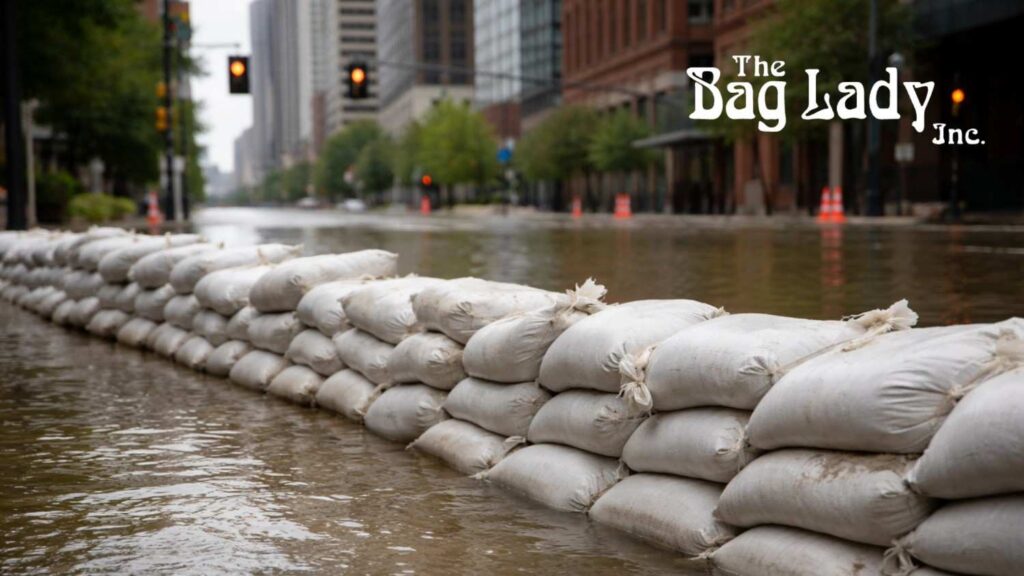
When a flood threat is hours away, bagging machines are the only tool capable of producing the volume of sandbags a large-scale response actually demands. Manual crews work hard, but they hit a ceiling fast. Fatigue sets in, output drops, and no amount of extra hands fully closes the gap. At The Bag Lady, we build equipment specifically for the moments when that ceiling cannot be an option.
The Cost of Manual Sandbagging at Scale
Manual sandbagging works for small jobs. But when flood response demands thousands of bags in a short window, the math turns against it fast.
The table below shows exactly how the Megga Bagger outperforms manual labor across every metric that matters in a flood emergency.
| Factor | Megga Bagger (MB Series) | Manual Labor |
| Output per hour | 1,000–3,500 bags/hr depending on model
(MB-1A/T1: avg 1,000; MB-2A/T2: avg 2,000–3,500) |
60–100 bags/hr
(crew of 4) |
| Manpower required | 1–2 operators | 8–12 workers per shift |
| Operator fatigue | Minimal; ergonomic, hands-free operation | High; physically demanding, injury risk rises fast |
| Consistency | Uniform fill weight and bag size every time | Variable; depends on worker condition |
| Deployment speed | Ready in minutes; trailer models (MB-T1/T2) move on-site fast | Slow to mobilize; needs coordination and staging |
| All-weather operation | Yes; built for outdoor and harsh conditions | Limited; worker safety restricts use in heavy rain/storms |
| Cost over time | Lower; fewer workers needed for same volume | Higher; labor costs multiply with scale |
| Scalability | Single station (MB-1A/T1) or double station (MB-2A/T2) to match output needs | Limited by available workforce and physical endurance |
If your crew is already stretched thin, learn how sandbag filling machines solve labor shortages during flood response.
How Do Bagging Machines Make Large-Scale Flood Preparation More Effective?
It comes down to five core advantages that a bagging machine delivers when manual labor cannot keep up with the scale of a flood threat.
They Produce Sandbags Faster Than Any Manual Crew
Speed is everything in flood response. The Megga Bagger MB-2A produces up to 3,500 sandbags per hour with just two operators. A well-organized manual crew of 8 to 12 workers can produce several hundred bags per hour under good conditions, but that output drops sharply as fatigue sets in, weather worsens, or coordination breaks down. When you need thousands of bags staged and ready before a storm surge hits, machine output is not a luxury; it is a requirement.
They Reduce the Manpower Burden on Emergency Teams
Large flood events strain every available resource. Bagging machines let you redirect personnel to other critical tasks including barrier placement, evacuation support, and equipment staging, while a one- or two-person team handles bag production. The Megga Bagger’s hands-free gate operation and ergonomic controls mean that even with minimal staffing, output stays high and operator fatigue stays low.
They Deliver Consistent, Reliable Bag Quality
Sandbags that are underfilled shift, settle, and fail. Overfilled bags are harder to stack and seal properly. Bagging machines use electronic variable speed controls and precision fill systems to produce uniform bags every time, regardless of operator fatigue or changing conditions. That consistency translates directly into flood barriers that hold.
They Operate in the Conditions That Stop Manual Crews
Heavy rain, wind, and cold temperatures slow manual labor and in severe conditions, they stop it altogether. The Megga Bagger MB-T2 is purpose-built for all-weather outdoor operation with weather-resistant components and robust construction. When the storm is already arriving, bagging machines keep running while manual crews are forced to take cover.
They Scale to Match the Threat
Not every flood emergency is the same size. The Megga Bagger lineup scales with the operation, from the compact MB-1A for agile, smaller deployments to the dual-station MB-T2 for maximum high-volume output at large-scale infrastructure sites. Trailer-mounted models like the MB-T1 and MB-T2 can be repositioned quickly as flood conditions shift, keeping production where it is needed most.
For teams managing citywide flood threats, see how municipalities should prepare with automated baggers.
What to Look for in a Bagging Machine for Flood Response
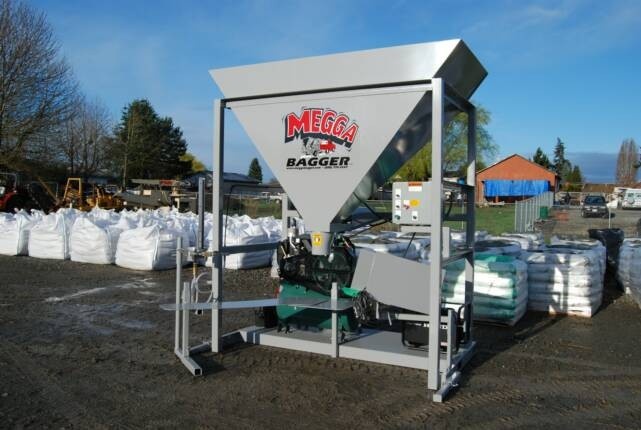
Not all bagging machines are built for emergency deployment. At The Bag Lady, we designed the Megga Bagger series around exactly these conditions. When evaluating your options, these are the features that make the difference between equipment that holds up under pressure and equipment that does not.
- High hourly output: Your machine should produce enough bags to meet your peak demand scenario. For large municipal or infrastructure operations, look for dual-station models capable of 3,400 or more bags per hour so your stockpile builds faster than the flood rises.
- Portability and on-site mobility: Flood conditions change fast. Trailer-mounted machines like the MB-T1 and MB-T2 can be towed directly to where sandbags are needed and repositioned as barriers shift. No fork-lift or heavy equipment is required for relocation.
- Minimal operator requirements: Emergency situations come with limited personnel. Choose a machine that a single trained operator can run efficiently, with intuitive controls that shorten the learning curve and reduce errors under pressure.
- All-weather durability: Flood response does not wait for clear skies. Machines built with weather-resistant components and all-weather operational capability keep production going in rain, mud, and cold conditions that are standard in flood scenarios.
- Adjustable bag size and fill settings: Different flood applications call for different bag specifications. Electronic variable speed controls and adjustable chute settings give you the flexibility to fine-tune fill weight and bag size for each specific use case.
- Low maintenance and proven reliability: In an emergency, there is no time for equipment failures. Look for machines backed by a track record in military, municipal, and emergency management applications, environments where reliability is non-negotiable.
When speed is everything, find out how to fill 1,000 sandbags in one hour during an active flood emergency.
Get the Right Bagging Machine Before the Next Flood Event
Flood preparation fails when equipment is not ready before the threat arrives. The Bag Lady’s Megga Bagger series is built specifically for large-scale flood response, and for teams that also need sandbags ready to deploy, The Bag Lady has you covered there too. Whatever your operation requires, there is a solution built for your scale and conditions.
Do not wait until storm warnings are already in effect. Contact The Bag Lady today to speak with an expert about bagging machines, sandbags, and everything your flood preparation needs.
Frequently Asked Questions
How many operators does a bagging machine require?
The number of operators depends on the model. The single-station models (MB-1A and MB-T1) are designed for efficient one-person operation. The dual-station models (MB-2A and MB-T2) accommodate two operators, one per chute. All models feature hands-free gate operation and ergonomic controls specifically engineered to minimize physical demand, making it feasible to maintain high output with a very small crew, even over extended shifts.
Can bagging machines be used in rain and harsh outdoor conditions?
Yes. The Megga Bagger MB-T2, in particular, is built with weather-resistant components designed for all-weather operation across various climates. Since flood emergencies almost always involve wet, windy, and cold conditions, the machines are constructed to keep running in exactly the environments where manual labor becomes unsafe or impractical.
What materials can bagging machines handle?
The Megga Bagger series is engineered to handle sand, soil, gravel, and similar granular materials commonly used in flood defense sandbags. The adjustable fill settings allow operators to calibrate output for different material densities, ensuring consistent bag weight regardless of what is being used.
Are bagging machines portable enough to deploy at multiple flood sites?
The trailer-mounted models, the MB-T1 and MB-T2, are specifically designed for mobility. They can be towed directly to any location that requires sandbag production and repositioned as flood conditions evolve. This makes them ideal for emergency management teams that need to respond across a wide area rather than from a single fixed location.
How difficult is it to train someone to operate a bagging machine?
The Megga Bagger series is designed to minimize training time so operators can achieve proficiency quickly. The controls are intuitive: load material into the hopper, set the desired bag size via the control panel, and the machine handles the rest. For emergency deployments where personnel may change frequently, this ease of operation is a significant advantage over complex equipment that requires extensive certification.
